(Pr) 2. Geology
Prince Colliery extracts coal from the Hub Seam near the Western margin of the Sydney coalfield. The Hub Seam is one of six major coal seams that are considered economically exploitable using modern mining technology. The sedimentary sequence containing the coal bears the characteristics of deposition in a fluvial environment upon a slowly subsiding coastal plain. The coal bearing strata occur within the Sydney Mines Formation of the Pictou Group. These strata are Carboniferous (Middle to late Pennsylvanian) in age.
The Prince Colliery reserve block covers an area of 29.18 sq.km (11.4 sq.mile). The southern boundary of this reserve is determined by the location of the 54 m (180 feet) solid cover line, which marks the minimum depth of mining in a submarine environment (Figure Pr1). The eastern limit is determined by coal quality. It coincides roughly with an in situ ash content of 20%. The western boundary is fixed by the Mountain Fault. To the North, coal reserves are defined on the basis of the confidence level for coal availability (2.4 km or 1.5 mile radius from data points) and distance from the shore-line (8 km or 5 miles).
The roof strata at Prince is composed primarily of mudstone, siltstone, and sandstone. A major paleo river channel, infilled with sandstone, crosses the reserve block, and locally erodes the entire coal seam.
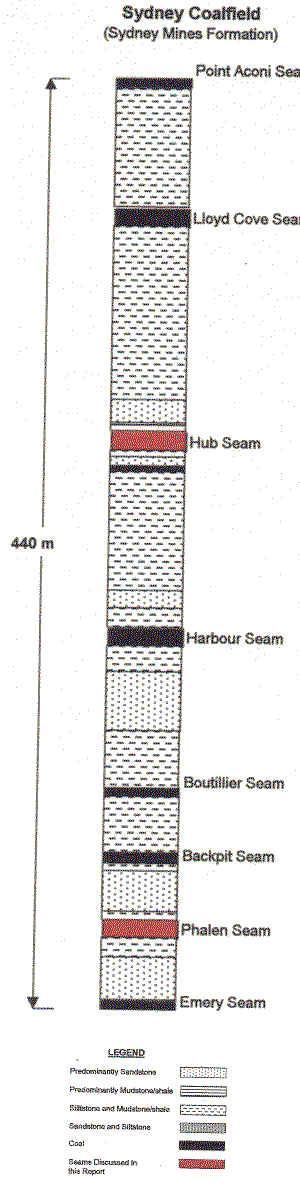
The immediate roof is composed of an underclay which is heavily rooted, and very sensitive to moisture. Dr. C. Mark found this unit to be 1.5 m (5 feet) and 1.8 m (6 feet) thick in two cores examined, and expected that its thickness could be as much as 6 m (20 feet) in future longwalls. The underclay is overlain by a medium grained, grey, medium bedded (10 cm or 4 inch. spacing) sandstone. Figure Pr2 shows the general roof strata and coal seams. Figure Pr3 illustrates the interpreted roof strata along the top and bottom gates of the #1 North longwall panel.
The immediate floor of the Hub Seam varies from a weak mudstone to moderately strong Siltstone seatearth.
(Pr) 2.2 Geological Structures
Geological features (Figure pr1) created during, and shortly after coal deposition have had a significant effect on mining at Prince Colliery. Some of these include the sandstone filled river channel, intercalated stone bands, etc.
Hub Seam deposition was terminated by the clastic sediments deposited by a rejuvenated Hub River crossing the peat swamp. The main channel of this river eroded deeply into the peat, and is preserved today as a series of discontinuous linear Sandstone bodies trending to the North-East. The local intensity of seam erosion, and the uncertainty of sandstone channel location, has limited the development of coal reserves east of the declines at Prince.
On the East side of the Prince Colliery reserve block, the upper half of the Hub Seam, contains up to six bands of stone ranging from 2.5 ~ 15 cm (1 ~ 6 inch.) thick. These are the fossil remains of flood-water borne sediment carried by both the Hub River and a presently unidentified river to the East. The coal surrounding these bands contains elevated levels of sulphur and ash. The bands trend northeast in a direction roughly parallel to their parent rivers. Two of these four bands (near the roof of the Seam) are tied directly to the Hub River.
The Mountain Fault is the most prominent structural feature in this area. It is located about 300 m (1000 feet) west of the Western boundary of the Prince reserve block.
The Mackenzie Syncline plunges eastward at an inclination of about 1°. Its origin is closely related to the tectonic events, which formed the Mountain Fault. The dip on the flanks of the fold ranges from 1 to 8 degrees. On the North limb of the Mackenzie Syncline, in the areas of #1, #2, and #3 North, the strike of the strata changes to a northerly direction forming a gentle anticlinal fold.
The sandstone in the roof of the Hub Seam possesses high porosity and permeability. Where the sandstone contains water, heavy dripping in the mine workings is encountered.
The thickness of the Hub Seam ranges from 2.1 ~ 2.4 m (7 ~ 8 feet). It thickens towards the west of the reserve block. In areas eroded by the Hub River, seam height may be significantly reduced; locally it may be totally removed (Figure Pr4). At Prince Colliery, the Hub Seam posesses a high volatile "B" bituminous rank. It is a thermal grade coal with ash content of 7 ~ 8%, a sulphur content of 3.5 ~ 4 %, and HGI of 55 ~ 65.
Figure Pr1: Geological map of Hub Seam in Prince Colliery.
Figure Pr2: Distribution of coal seams and roof strata in Sydney coalfield.
Figure Pr3: Interpreted roof strata of panel #1 North.
Figure Pr4: Thinning of the Hub Seam due to Sandstone filled paleo river channel.
Figure Pr5: Mine plan of the Prince Colliery.